
How Can Vision Therapy Help Correct Crossed Eyes Without Surgery?

When a parent or adult first notices an eye drifting or turning, the term "crossed eyes" is often the first description that comes to mind. Clinically known as “strabismus”, this condition is frequently misunderstood as a simple muscle weakness. This misconception leads many to believe that surgery, physically altering the eye muscles, is the only path to correction.
However, modern neuroscience suggests that strabismus is often a challenge of brain-eye coordination rather than a purely physical muscle defect [1]. By focusing on how the brain controls the eyes, vision therapy offers a comprehensive, non-surgical solution that addresses the functional cause of the turn.
What Is "Crossed Eyes" And Why Does It Happen?
Strabismus is a visual condition where the two eyes do not align under the same point of focus at the same time. While one eye looks straight at an object, the other eye may turn in a different direction.
What Are Crossed Eyes?
In a healthy visual system, both eyes send slightly different images to the brain, which then fuses them into a single, three-dimensional picture. In cases of strabismus, the misalignment prevents this fusion [2]. Common symptoms include:
Double vision (diplopia).
Frequent tilting of the head to see better.
Loss of depth perception (clumsiness or difficulty with sports).
Eyestrain and headaches during near tasks.

Many families seek non-surgical options because they want to address the "why" behind the eye turn, rather than just the "where" the eye is pointing. They look for solutions that avoid the risks of general anaesthesia and the possibility of post-surgical regression.
Why Does It Happen?
Strabismus occurs when the neurological signals from the brain to the six extraocular muscles are uncoordinated. Potential causes include:
High Refractive Errors: Severe long-sightedness (hyperopia) can cause a child to over-focus, pulling the eyes inward.
Brain-Eye Communication Failure: The "software" in the brain responsible for binocular fusion fails to keep the eyes aligned.
Neuro-developmental Delays: Hidden barriers in early development that affect motor control and sensory processing.
How Do I Know If My Child Has This Condition?
Strabismus can sometimes be difficult to notice, especially when the eye turn is mild or only happens occasionally. Understanding the different ways can help parents spot the signs earlier:
Constant vs. Intermittent: The turn may be present all the time, or it may be intermittent, appearing only when the child is tired, stressed, or ill [1].
Direction of the Turn:
Esotropia: One or both eyes turn inward toward the nose.
Exotropia: One or both eyes turn outward toward the temple.
Hypertropia/Hypotropia: One eye drifts vertically (upward or downward).
If you notice your child squinting in sunlight or closing one eye to read, these are often compensatory behaviours used to shut out a confusing second image [2].

How Is Strabismus Treated?
Choosing a treatment path requires an objective understanding of how each method works. Below is a comparison of standard treatments ranging from non-surgical interventions to surgical correction.
Strabismus Treatment Comparison Table
Non-surgical treatments | |||
Treatment Method | Mechanism/ Goal | Indications | Key Considerations |
Vision Therapy | Retrains brain-eye coordination and binocular fusion | All types of functional strabismus | Non-invasive; treats the neurological root cause |
Glasses/ Contacts | Corrects refractive errors to reduce focusing strain | Accommodative esotropia | Often used as the first treatment, but glasses alone may not fully correct the eye turn |
Prism Lenses | Shifts the image to align with the eye's resting position | Double vision or small misalignments | Provides immediate relief but does not "cure" the turn, and may become less effective as the angle of strabismus is often not stable |
Patching | Forces the brain to use the "weaker" eye | Amblyopia (lazy eye) is associated with strabismus | Does not teach the eyes to work as a team |
Botox Injections | Temporarily weakens a muscle to allow realignment | Specific adult cases or small turns | Temporary effect; requires repeated applications |
Strabismus surgery | |||
Treatment Method | Mechanism/ Goal | Indications | Key Considerations |
Strabismus Surgery | Physically shortens or moves the eye muscles | Large-angle turns or congenital cases | Primarily cosmetic alignment; high risk of regression without therapy |
How Does Vision Therapy Naturally Correct The Alignment?
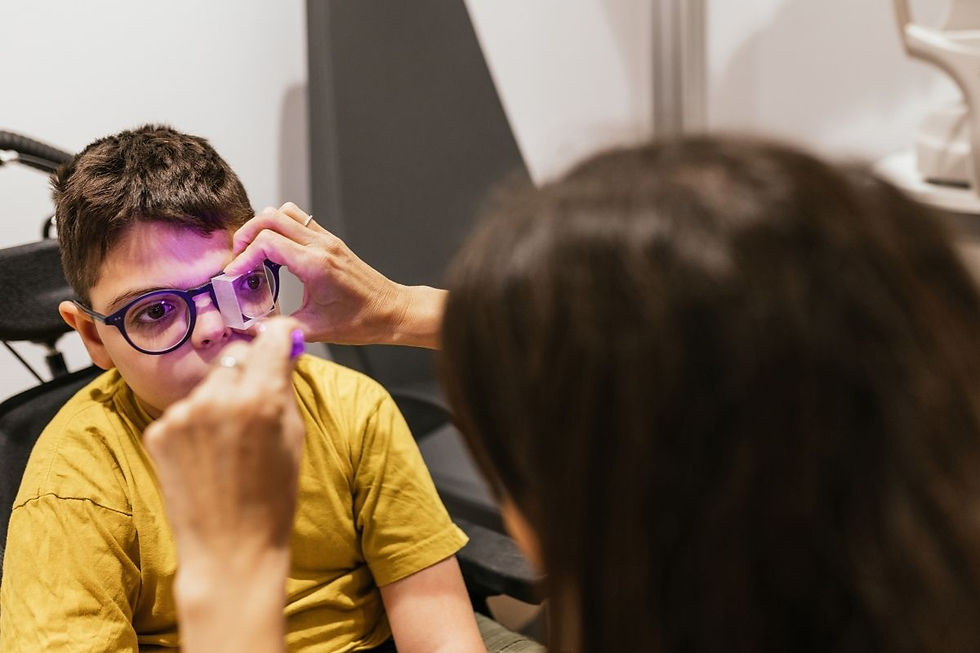
Vision therapy corrects strabismus by using the principles of neuroplasticity to retrain the brain's control over the eye muscles. Through a personalised programme of lenses, prisms, and space-matching exercises, the brain is taught to "lock" both eyes onto a single target simultaneously. This process develops binocular fusion and depth perception, making correct alignment a subconscious neurological habit rather than a forced physical effort [1].
Unlike surgery, which physically adjusts the eye muscles, vision therapy focuses on training the brain and eyes to work together properly. When the brain learns that using both eyes together provides a clearer, more comfortable 3D world, it naturally maintains that alignment [2].
How Does Orthovision Singapore Approach Treatment?
At Orthovision Singapore, we do not believe in managing symptoms in isolation. We treat the visual system as a whole, focusing on the deep connection between the eyes, the brain, and the body.
The Comprehensive Assessment: Our process begins with a Comprehensive Visual Cognitive Assessment. We stress-test the eyes to find the exact point where their teamwork breaks down, identifying whether the issue is sensory, motor, or a combination of both.
The INPP Advantage: Our founder, Zoran Pejic, is the only licensed INPP practitioner in the region. This allows us to screen for underlying neuro-motor immaturities or retained primitive reflexes that may be sabotaging the child's ability to control their eye movements.
ICORE Methodology: We use Integrated Cognitive Orthoptic Remediation (ICORE) to build the stamina and speed of the eye muscles. We ensure that both sides of the brain communicate effectively, allowing the eyes to work as a resilient, high-performing team.
Strabismus is a complex neurological challenge, but it does not always require a surgical scalpel. By retraining the brain to lead the eyes, vision therapy offers a natural, lasting, and non-surgical solution.
Ready to find a lasting solution for an eye turn? Book a Functional Vision Assessment with Orthovision Singapore today to understand how we can help you achieve visual balance.
References
[1] American Optometric Association (AOA). Strabismus (Crossed Eyes): Diagnosis and Treatment.
[2] College of Optometrists in Vision Development (COVD). Non-Surgical Treatment for Strabismus.
[3] American Academy of Ophthalmology (AAO). Strabismus Surgery and Outcomes.


I just finished reading "How Vision Therapy Corrects Crossed Eyes Without Surgery", and I liked how clear and grounded the writing felt. I also liked how you touched on fullscreen black screen. I will revisit this post again.